Agentic DevOps: How AI Agents Are Changing Cloud Operations
A production incident rarely follows the path anyone predicted. Traffic spikes on the wrong service, a deployment interacts badly with a config change from two weeks ago, and the alert that fires points at a symptom three layers away from the cause. Traditional automation handles the incidents it was written for. It doesn't reason through the ones it wasn't. That gap is where Agentic DevOps starts to matter. Not because AI is going to replace the on-call engineer, but because an agent can pull together logs, metrics, deployment history, and a runbook faster than a human can open five browser tabs, proposing a next step grounded in what it finds. What it does with that step, whether it just tells you or actually acts, is the governance problem this article is about.
A production incident rarely follows the path anyone predicted. Traffic spikes on the wrong service, a deployment interacts badly with a config change from two weeks ago, and the alert that fires points at a symptom three layers away from the cause. Traditional automation handles the incidents it was written for. It doesn't reason through the ones it wasn't.
That gap is where Agentic DevOps starts to matter. Not because AI is going to replace the on-call engineer, but because an agent can pull together logs, metrics, deployment history, and a runbook faster than a human can open five browser tabs, proposing a next step grounded in what it finds. What it does with that step, whether it just tells you or actually acts, is the governance problem this article is about.
What Is Agentic DevOps?
Agentic DevOps is the use of AI agents that can observe operational context, reason about it, decide on an action, execute that action through defined tools, and verify the result, within boundaries an organization sets in advance.
The core loop looks like this: observe, understand, decide, act, verify, adapt. An agent pulls telemetry or reads a ticket (observe), interprets it against the system's current state (understand), picks a next step from an approved set of actions (decide), calls a tool or API to carry it out (act), checks whether the outcome matches expectations (verify), and adjusts its next move accordingly (adapt). It repeats this loop across multiple steps rather than executing one instruction and stopping.
This differs from what most teams run today:
- Scripts and cron jobs execute a fixed sequence regardless of context.
- CI/CD pipelines branch on conditions someone anticipated, not live reasoning.
- Conventional monitoring alerts notify a human but don't investigate or decide next steps.
- Chat-based AI assistants suggest commands, but a person still copies and runs each one.
An agent's distinguishing trait is the multi-step loop: it chains observation to decision to action to verification without a human re-prompting it each time. That's also why it needs tighter boundaries than any pattern above. A script's blast radius is whatever the script does; an agent's blast radius is whatever the loop decides to do, across however many iterations it runs.
It's worth being precise about "understand" here. An agent doesn't understand a system the way an engineer who built it does. It analyzes available context, matches patterns against what it has seen, and reasons over signals within its context window: pattern-based reasoning, not comprehension.
The differences above are easier to compare side by side:
| Aspect | Traditional Automation | AI-Assisted DevOps | Agentic DevOps |
| Decision-making | Fixed rules | Human decides, AI suggests | Agent decides within policy bounds |
| Execution | Scripted | Human typically reviews or initiates actions | Agent executes through defined tools |
| Adaptability | Limited to predefined rules and conditions | Limited to what the human tries next | Adjusts next action based on verification |
| Human involvement | Setup and maintenance | Typically reviews and runs each suggested action | Varies by maturity level |
| Risk controls | Script logic and operational controls | Human judgment | Permissions, policy, approval gates, audit trail |
How Agentic DevOps Works
A practical architecture has a few layers that stay analytically separate, even when built together.
Agentic DevOps Architecture: From Context to Verified Action
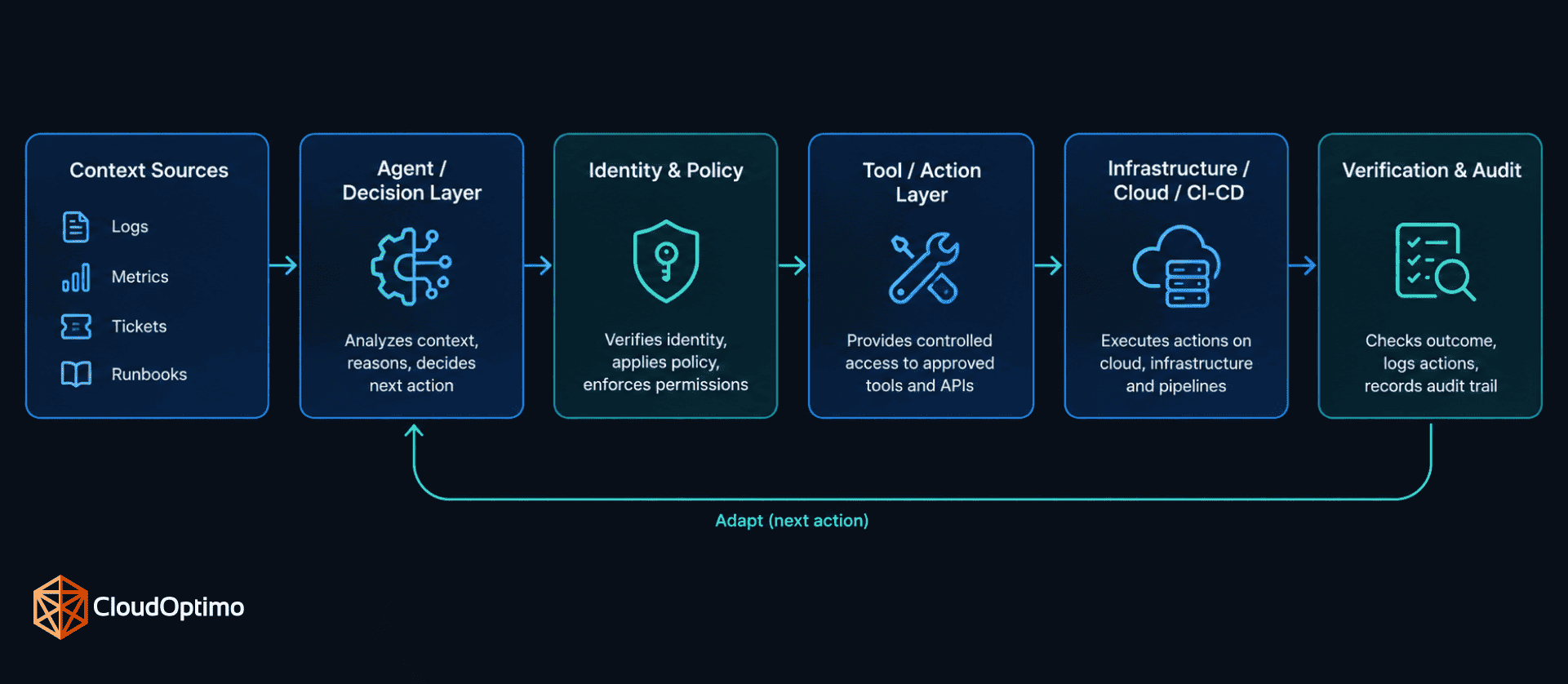
Figure: A production Agentic DevOps architecture routes every action through identity, policy, and a constrained tool layer before it touches infrastructure, then verifies and audits the outcome, feeding results back into the agent's next decision.
Context sources. Telemetry, source control history, CI/CD state, cloud infrastructure state, ticketing systems, and runbooks: what the agent observes.
Reasoning layer. The system that interprets context, correlates signals, and proposes a next action: where the agent decides.
Tool and action layer. A constrained set of callable functions: querying a metrics API, posting to a ticket, restarting a service, requesting a rollback. The agent acts only through this layer, which exposes only what's explicitly registered.
Identity and authorization. The credentials and permission scope behind each tool call: what the agent is technically capable of, separate from what it's allowed to decide.
Policy and governance. Rules constraining which actions are permitted in which environments and up to what limits, turning "the agent can call this API" into "the agent may call this API here, now, within these bounds."
Approval mechanisms. A gate routing specific actions to a human before execution, based on policy.
Audit and observability of the agent. A record of what it observed, decided, did, and verified.
None of this requires a specific vendor architecture. It can be built with existing CI/CD tooling, IAM, and observability platforms wired to a reasoning layer through a constrained tool interface.
Real-World Use Cases
The most useful distinction in every use case below is whether the agent recommends an action or executes it.- Incident investigation. The agent correlates logs, metrics, and recent deployments to propose a likely cause, almost always a recommendation for an on-call engineer to judge.
- Log and metric analysis. Summarizing anomalies across a noisy telemetry surface faster than manual dashboard review. Recommendation, not action.
- Deployment verification. After a rollout, the agent checks error rates and latency against baseline and flags regressions, recommending a rollback or, in a narrow pre-approved case, triggering one directly.
- Infrastructure remediation. Restarting a crashed service or clearing a stuck queue are bounded, reversible actions some teams let an agent execute directly, inside a defined scope.
- Cloud cost anomaly detection. The agent flags unexpected spend tied to a resource or deployment. This should stay a recommendation, since the fix carries financial and availability consequences.
- Ticket enrichment. The agent drafts a timeline and probable cause into a ticket for review, low risk since it doesn't touch production.
This distinction is the same one the maturity levels below are built around: whether a human remains the checkpoint before anything changes, or the organization has already decided this action, in this environment, doesn't need one.
Agentic DevOps Maturity Model
A practical maturity model separates four levels, defined by how much an agent is trusted to do without a human confirming first. Not every team should target the highest level on day one.
Level 1: Recommend. The agent proposes a cause or remediation and a human decides, such as flagging a likely cause for a latency spike. Often a practical starting point, though the right level for a given workflow depends on its own risk and maturity, not a universal default. Risk: alert fatigue if recommendations outpace review capacity.
Level 2: Human-Approved Execution. The agent prepares a specific action and requests approval first, such as confirming a rollback after a failed canary. Risk shifts to approval fatigue from a flood of low-stakes requests.
Level 3: Bounded Autonomous Execution. The agent executes pre-approved, reversible actions directly within a fixed environment and resource scope, such as restarting a crashed pod in staging. Risk concentrates in the boundary itself: too wide a scope turns bounded execution into unbounded execution.
Level 4: Controlled Adaptive Automation. The agent chains bounded actions across a workflow, adapting its next step based on verification, while remaining subject to whatever policy, identity, and cost controls the organization has configured for that environment. Not full autonomy; every action still traces to an explicit permission. Risk: compounding, where an early misjudgment cascades before verification catches it.
Most organizations move through these levels gradually; many workloads stay at Level 1 or 2 indefinitely.
Agentic DevOps and Cloud Cost Governance
Deploy, secure, and observe are not enough. An agent that can launch infrastructure, scale resources, change instance types, provision a database, request GPU capacity, or raise autoscaling limits can generate real cloud spend within minutes. This is a governance concern, not a monitoring feature to add later. Every such decision follows a spend path from decision to permission to execution to invoice, and each link on that path needs its own control.
Being technically capable of calling a resource-creating API is not the same as being authorized to call it. An agent might hold credentials that permit launching a large instance type; whether it's allowed to, in which environment, and up to what cost, is a separate control the organization must define, not something assumed from the fact that the call would succeed.
Production Agentic DevOps needs, at minimum:
- Permission boundaries and least-privilege IAM, scoped to only what the use case requires.
- An approved action list, so the tool layer never exposes broader operations than intended.
- Environment restrictions, so an agent scoped to staging cannot reach production.
- Resource and scaling limits, capping instance sizes, counts, or regions.
- Cost thresholds and budget alerts, tied to the specific resources an agent can touch, not just account-wide spend.
- Approval gates for expensive or destructive actions, routing anything above a defined threshold to a human.
- Temporary, short-lived credentials, limiting exposure from a compromised or misbehaving session.
- Action logging and lifecycle controls, with automatic cleanup where appropriate, so provisioned resources don't linger unbilled and unnoticed.
A budget alert alone does not stop an agent from creating expensive resources; it only reports, after the fact, that spend crossed a line. Authorization and policy controls constrain what the agent can do in the first place. Budgets and alerts are a backstop, not a substitute for scoped permissions.
Security and Governance
Four concepts get conflated often enough to separate explicitly. Observability tells you what happened. Authorization determines what the agent is allowed to do. Policy determines under what conditions it may act. Approval gates determine which of those actions still require a human before execution.
A few specifics matter in practice. Least-privilege IAM and short-lived credentials limit exposure if a session is compromised or reasons into an unintended action. Secrets should not be placed in an agent's context window in plaintext; they belong in a secrets manager, retrieved only when a tool call needs them. Tool permissions should be scoped per environment, not granted globally, and network restrictions should keep an agent's execution environment from reaching systems outside its scope.
Prompt injection deserves specific mention: an agent reading logs, tickets, or external data as context can encounter untrusted content crafted to manipulate its decision. Treat any data source it reads as potentially adversarial, and keep the tool layer narrow enough that even a manipulated decision has limited consequence. Destructive actions, deleting data or terminating infrastructure, should sit behind an approval gate by default, not an exception process.
A Practical Production Example
This is a hypothetical scenario, not a real customer case, meant to illustrate how the pieces fit together.
An agent monitoring infrastructure detects abnormal EC2 utilization shortly after a deployment. It inspects the relevant metrics, correlates them against application logs from the same window, and compares the timing against recent deployment history, finding the anomaly started within minutes of a specific release. It checks infrastructure state to confirm which instances are affected, then consults the service's runbook for a documented remediation.
Based on that, it proposes rolling back the deployment. Before acting, it checks policy: is a rollback within its approved action list for this environment, and does it cross any cost or risk threshold requiring approval? Here it does, so it requests approval from the on-call engineer rather than executing directly. Once approved, it triggers the rollback through the existing CI/CD mechanism, verifies utilization returns to baseline, and records the full trail, what it observed, proposed, was approved, and verified, in the incident ticket.
Nothing in that sequence required the agent to have standing production write access. It needed read access to observe, a narrow and pre-approved rollback action, and a gate that routed the decision to a person before anything changed.
When Agentic DevOps Makes Sense, and When It Doesn't
It's a reasonable fit for repetitive investigation, bounded workflows, large infrastructure where manual correlation is slow, incident triage, cost anomaly detection, and pulling knowledge out of scattered runbooks and tickets.
It's a poor fit in poorly understood environments, systems without mature observability, no defined rollback procedure, unclear approval ownership, and destructive operations without an approval gate. It's also unnecessary where deterministic automation already solves the problem. Agentic reasoning earns its place when the path isn't known in advance.
Conclusion
Agentic DevOps is not about giving an AI system unrestricted access to production. The agent loop, observe, understand, decide, act, verify, adapt, is useful for the ambiguous, cross-system investigation traditional automation can't handle. Usefulness and safety come from the same source: narrowly scoped tools, explicit policy, least-privilege identity, defined cost boundaries, and approval gates on anything expensive or destructive.
The goal isn't maximum autonomy. It's controlled autonomy at whatever maturity level a team is ready for: enough context to be genuinely useful, and few enough permissions that a wrong decision stays cheap to reverse.
Frequently Asked Questions (FAQs)
Q1: What is Agentic DevOps?
Agentic DevOps refers to AI agents that observe operational context such as logs, metrics, and deployment history, reason about what it means, decide on a next action, execute it through a defined set of tools, and verify the outcome, within permission and policy boundaries set in advance.
Q2: How is Agentic DevOps different from DevOps automation?
Traditional automation, scripts, cron jobs, CI/CD pipelines, executes a predefined sequence regardless of context. Agentic DevOps involves a reasoning loop that interprets new information and adapts its next action, chaining steps together without a human re-prompting each one.
Q3: Can AI agents make production changes?
An agent can be technically capable of calling an API that changes production infrastructure, but whether it's authorized to is a separate decision. Mature implementations distinguish actions an agent can only recommend from a narrow, pre-approved set of reversible actions it may execute directly, with approval gates on anything expensive or destructive.
Q4: How do you control cloud costs when using autonomous DevOps agents?
Cost control requires scoped permissions, not just monitoring. Least-privilege IAM, an approved action list, environment restrictions, resource limits, and approval gates above a defined cost threshold constrain what an agent can provision. Budget alerts are a useful backstop, but they only report spend after it happens.